The Delivery Gap Is an Equipment Problem: Specifying for the Twenty Minutes After the Ticket

Photo by Photo by Ceba Solutions on Unsplash on Unsplash
A dine-in order has a natural ending: the plate reaches the table, the guest begins to eat, and the kitchen's responsibility fades. A delivery order has no such clean handoff. The ticket closes, the food is packaged, the bag waits on a shelf, a driver arrives, and the order travels through traffic. The most fragile minutes often happen after the kitchen has already moved on to the next ticket. Most equipment lineups are still designed for dine-in timing, which is why the delivery gap is an equipment specification problem hiding in plain sight.
The Ticket Closes; the Clock Starts
In a dine-in kitchen, a fried item is plated and served within a minute or two. In a delivery kitchen, that same item may sit in a holding cabinet, be bagged, wait for a driver, and spend another fifteen to twenty-five minutes in a vehicle. The equipment must protect texture, temperature, and moisture through that entire window, not just long enough to pass a quick quality check at the pass.
The first step is to define the real delivery window. Do not use the ideal serving time from a recipe card. Use the actual elapsed time from the moment the item leaves the fryer or oven to the moment the guest opens the bag. Pull data from your point-of-sale system, delivery tablets, and driver check-in logs. If the average is twenty-two minutes and the peak is thirty-five, specify for the peak, then decide how much quality drift you are willing to accept.
Holding Cabinets Are Not Warming Drawers
A warming drawer can keep food hot. It cannot necessarily keep fried food crisp, bread soft, or vegetables from turning limp. Holding cabinets differ in airflow, humidity control, shelf spacing, and recovery time. A cabinet that recovers slowly after the door opens will lose temperature every time a busy expediter loads another order. A cabinet with poor humidity control can turn a crisp shell soggy or dry out a protein.
Ask for a loaded recovery test, not a brochure number. Put a full load of the actual menu items into the cabinet, open the door for the same amount of time a server would, close it, and measure how long the cabinet takes to return to its set temperature. Repeat that test three times. Ask about temperature uniformity across shelves. The top shelf and the bottom shelf should not be different climates. Ask how the cabinet performs when it is only half full, because delivery volume is rarely perfectly balanced.
Fryers and Reheat Units: The Crispness Window
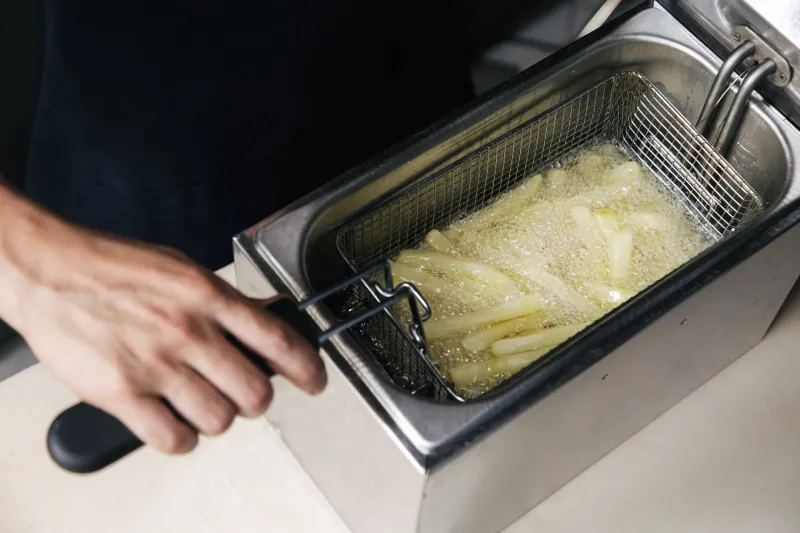
Fried food is the hardest delivery item to protect. A fryer with slow recovery time will produce batches that are pale and greasy during a rush, and those defects become more obvious after a twenty-minute ride. Look at recovery time between batches, not just the nominal output rating. Ask how many baskets can be dropped back-to-back before the oil temperature falls below the manufacturer's recommended range. Ask how filtration frequency affects recovery.
Reheat units matter for par-cooked and chilled items. A reheat unit that heats unevenly can leave a protein hot at the edge and cool in the center, which is both a quality and a food-safety problem. Ask for a time-and-temperature validation with your actual product, not a generic tray of water. If the unit uses convection, confirm that the fan pattern does not dry out exposed edges. If it uses steam, confirm that condensation does not pool in packaging.
Packaging Stations and Staging Space
Packaging is not a table with bags on it. It is a production station with ergonomics, sealers, label printers, cup dispensers, and a staging area that separates hot from cold. A cramped packaging station creates bottlenecks: the fryer operator waits for a bag, the bag waits for a label, the label waits for a receipt. During a delivery rush, those small waits compound into cold food.
Staging space deserves the same scrutiny. Bags should not sit directly under a heat lamp or beside a drafty back door. If the staging shelf is unheated, the food begins losing temperature the moment it is bagged. If it is overheated, packaging can sweat and fried items can soften. Ask whether the staging area has a dedicated holding solution with controlled temperature and ventilation, and whether drivers can pick up orders without walking through the cook line.
Test Against the Delivery Window, Not the Ideal Plate
Before you buy, run a delivery simulation. Choose the five highest-volume delivery items. Cook them according to your standard procedure. Hold them for the expected window, package them, and hold them for another ten minutes to represent driver wait and travel. Then evaluate temperature, texture, moisture, and packaging integrity. Use a calibrated thermometer and a simple score sheet. Repeat the test at peak volume, not during a slow afternoon.
If an item fails, do not immediately blame the recipe. Ask whether the holding cabinet, fryer recovery, reheat unit, or packaging station is the weak link. Sometimes the fix is a different cabinet. Sometimes it is a smaller batch size. Sometimes it is a staging shelf in the wrong place. The point is to find the constraint before it becomes a stream of refund requests and low ratings.
Specification Questions for Your Supplier
Ask for recovery times under loaded conditions, temperature uniformity data, humidity control range, cleaning access, and warranty terms for delivery-heavy use. Ask how the equipment performs when the kitchen is hot and the door is opening every ninety seconds. Ask whether the unit is designed for commercial volume or light-duty use. A supplier who can answer those questions is a partner. A supplier who can only quote a catalog number is not.
Prathiksha Kitchen Equipments approaches delivery equipment as part of the production line, not as a collection of appliances. The delivery gap is short, but it decides whether the guest experiences the food you intended to send. Specify for the twenty minutes after the ticket, and the kitchen has a far better chance of surviving the trip.