Built to Pivot: Why Equipment Versatility Is the Most Valuable Investment in an Unpredictable Restaurant Market
Photo: Cosign India, CC0, via Wikimedia Commons
The Market Does Not Wait for Your Equipment Plan
Restaurant operators are accustomed to planning. Menu engineering, staffing schedules, vendor contracts, seasonal promotions—the business of running a food service operation is largely the business of anticipating what comes next. But the past several years have demonstrated, with considerable force, that anticipation has its limits. Consumer preferences shift. Supply chains fracture. Dining formats that seemed permanent become suddenly obsolete, and new models emerge in their place almost overnight.
What separates the operators who navigated these disruptions from those who did not is not always concept strength or brand recognition. Frequently, it is the physical capability of their kitchens to do something different. Equipment flexibility—the ability to reconfigure production, expand menu scope, or shift service formats without a capital-intensive overhaul—has emerged as one of the most undervalued dimensions of commercial kitchen investment.
When Single-Purpose Equipment Becomes a Strategic Liability
The appeal of single-purpose commercial equipment is real. A dedicated pizza deck oven, a purpose-built rotisserie, a specialty waffle iron designed for a signature menu item—each of these represents optimized performance for a specific application. When the menu is stable and customer demand is predictable, that optimization is an asset.
But when circumstances change—when a key ingredient becomes cost-prohibitive, when a dining trend reverses, when a new revenue channel demands a different production capability—single-purpose equipment offers no path forward. It either sits idle or forces the operator to absorb the capital cost of acquiring additional equipment alongside the asset that no longer serves its original purpose.
This is the strategic liability that forward-thinking operators have begun to design around. Rather than building kitchens around the menu of today, they are building kitchens around the operational flexibility of tomorrow.
The Modular Advantage: Real-World Adaptability
Consider the experience of a mid-sized casual dining restaurant in the Southeast that, like many operators, saw its dine-in volume collapse during the pandemic period and shifted aggressively toward takeout and delivery. The operators who adapted most successfully were often those running kitchens equipped with combi ovens, multi-zone induction cooking suites, and modular prep equipment that could be reconfigured without specialized labor.
A combi oven, for example, combines steam, convection, and combination cooking modes in a single unit. An operator pivoting from plated entrées to family-style meal kits can use the same piece of equipment to batch-roast proteins, steam vegetables, and proof bread—production tasks that would otherwise require three separate units. The capital investment is singular; the operational application is broad.
Similarly, operators who had invested in modular cold storage configurations found it significantly easier to reallocate refrigeration capacity as their product mix shifted—reducing prepared-food storage and expanding raw ingredient capacity when production volumes changed, or vice versa, without acquiring new units.
Equipment Flexibility as Supply Chain Insurance
The supply chain disruptions that have affected the food service industry since 2020 introduced a different kind of pressure on kitchen equipment strategy. Operators whose menus depended on specific proteins, produce varieties, or imported ingredients found themselves in a difficult position when those items became scarce or prohibitively expensive. The ability to substitute—to pivot a protein-forward entrée to a vegetable-centric dish, or to shift from one cooking technique to another—is partly a culinary question and partly an equipment question.
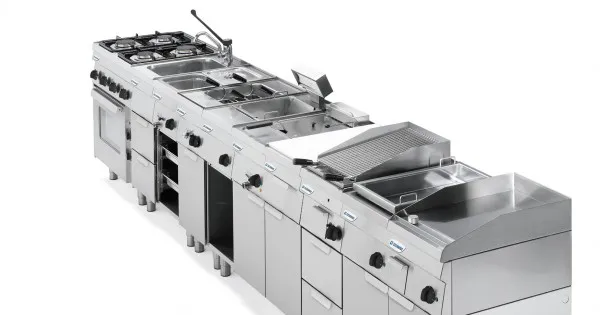
A kitchen built around a single cooking methodology has limited substitution capability. A kitchen equipped with induction burners, a combi oven, a commercial salamander, and a versatile tilting skillet can execute a far wider range of preparations, which translates directly into a wider range of substitution options when primary ingredients become unavailable.
For operators in markets where supply chain volatility remains a persistent concern, equipment versatility is not a luxury feature. It is a risk management tool that reduces the kitchen's dependency on any single ingredient category or preparation method.
Designing for Flexibility: Key Equipment Categories to Prioritize
For operators who are building new kitchens or planning significant equipment refreshes, several categories of commercial equipment offer particularly strong versatility returns:
Combi Ovens: The single most versatile cooking unit available in commercial kitchens, capable of executing roasting, steaming, braising, proofing, and smoking functions within a single footprint. Modern combi ovens from leading manufacturers also offer programmable recipe storage, which supports consistency across staff skill levels.
Tilting Skillets and Braising Pans: These units can function as griddles, sauté pans, braising vessels, steamers, and holding units. For high-volume operations that need to shift between breakfast, lunch, and dinner production, a tilting skillet dramatically reduces the number of discrete units required.
Modular Induction Cooking Suites: Unlike gas ranges with fixed burner configurations, modular induction suites allow operators to reconfigure cooking zones as menu needs evolve. They also offer the operational advantage of zone-specific temperature control and significantly reduced ambient heat in the kitchen.
Blast Chillers with Multi-Mode Functionality: Advanced blast chillers that also function as holding cabinets or shock freezers give operators greater flexibility in managing production timing—an increasingly important capability as catering, meal-kit, and delivery revenue streams operate on different production schedules than traditional dine-in service.
The Capital Efficiency of Versatility
There is a financial argument for versatility that extends beyond risk management. Multi-functional equipment frequently delivers stronger capital efficiency than an equivalent array of single-purpose units. A single combi oven that replaces a convection oven, a steamer, and a holding cabinet represents not only a smaller equipment footprint but also reduced utility connections, lower maintenance complexity, and fewer vendor service relationships to manage.
For operators working within constrained kitchen square footage—a reality for many urban restaurant concepts—this capital efficiency has spatial dimensions as well. Equipment that performs multiple functions allows operators to allocate recovered floor space to additional production capacity, prep stations, or storage, all of which contribute to operational throughput.
Investing in Adaptability Is Investing in Longevity
The restaurant market will continue to evolve. Consumer preferences around health, sustainability, and dining format will shift. Supply chains will experience periodic disruption. New revenue models—ghost kitchens, virtual brands, catering subsidiaries—will create opportunities for operators who can serve them without building entirely new production infrastructure.
The operators who are best positioned to capture those opportunities are not necessarily those with the largest budgets or the most sophisticated concepts. They are the ones who built their kitchens with intentional flexibility—who chose equipment that could grow with their business rather than equipment that defined its limits.
In a market that rewards adaptability above almost every other operational virtue, the most strategic investment a restaurant operator can make may be the one that ensures their kitchen is never truly locked in.