When Equipment Hurts Your People: The Ergonomic Blind Spot That Exposes Restaurants to Serious Legal Risk
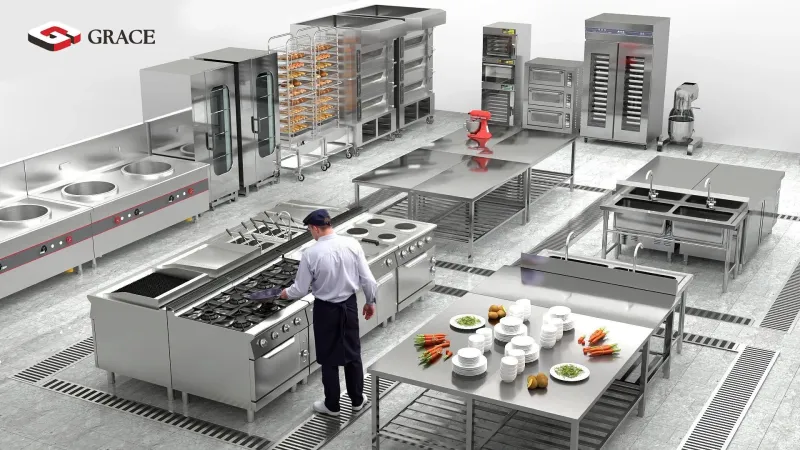
Photo: commercial kitchen ergonomic workstation chef working professional restaurant equipment, via www.gracekitchenequip.com
Most restaurant operators think carefully about fire suppression systems, slip-resistant flooring, and food safety protocols. Far fewer apply the same rigor to the ergonomic profile of the equipment their staff interacts with for eight, ten, or twelve hours a day. That oversight carries consequences—not just in human terms, but in the form of workers' compensation claims, OSHA citations, and, in some cases, civil litigation that can threaten the financial viability of an otherwise well-run operation.
The commercial kitchen is one of the most physically demanding environments in the American workforce. According to the Bureau of Labor Statistics, food service workers experience injury and illness rates that consistently exceed the national average for all private-sector industries. A meaningful portion of those incidents are not the result of acute accidents—slips, burns, or cuts—but of cumulative physical stress that builds over weeks and months of working with equipment that was never designed with the human body in mind.
The Anatomy of a Repetitive Strain Claim
Repetitive strain injuries (RSIs) and musculoskeletal disorders (MSDs) develop gradually, which is precisely what makes them so difficult to anticipate and so expensive once they materialize. A line cook who spends six hours a shift reaching across an improperly positioned prep table, or a dishwasher whose workstation requires sustained awkward wrist positioning, may not report discomfort until the injury has progressed significantly. By that point, the path to a workers' compensation claim—or a formal complaint to OSHA—is often already underway.
What many operators fail to appreciate is that the design and placement of kitchen equipment are not incidental to these outcomes. They are central to them. A range positioned too low for a tall cook. A reach-in refrigerator with a door handle that requires repeated twisting motions. A prep sink installed at a height that forces sustained forward bending. Each of these configurations introduces physical stress that, compounded over time, produces the exact injuries that generate claims.
Equipment Design as a Legal Defense
Here is where the conversation shifts from operational to legal. When a workers' compensation claim is filed—or when an injured employee pursues civil remedies—the employer's choices regarding equipment procurement and workstation design become part of the evidentiary record. Attorneys and OSHA investigators examine whether the employer took reasonable precautions to provide a safe working environment. In a commercial kitchen context, that examination increasingly includes the ergonomic characteristics of the equipment in use.
Operators who have invested in height-adjustable prep stations, equipment with clearly ergonomic handle and control placement, and layout configurations that minimize unnecessary reaching and bending are in a substantially stronger legal position than those who selected equipment based solely on price or production capacity. Professional-grade equipment from reputable manufacturers is often designed with ergonomic standards in mind—standards that, when documented and applied, can serve as a meaningful component of an employer's duty-of-care defense.
Conversely, operators who have continued using equipment with known ergonomic deficiencies—or who have arranged workstations in ways that create foreseeable physical stress—face a harder argument when defending against injury claims. The principle of foreseeability is critical in tort law: if a reasonable operator should have known that a particular equipment configuration posed a risk of injury, and chose not to address it, that failure can constitute negligence.
The Insurance Premium Connection
Beyond litigation risk, ergonomic deficiencies have a direct and measurable impact on insurance costs. Workers' compensation premiums in most states are experience-rated, meaning that an employer's claims history directly influences what they pay. A single significant RSI claim can elevate a restaurant's experience modification rate (EMR) for years, resulting in premium increases that dwarf the cost of the ergonomic equipment upgrades that might have prevented the injury in the first place.
Some commercial insurers now explicitly assess ergonomic risk as part of underwriting for food service accounts. Operators who can demonstrate that they have invested in equipment designed to reduce physical strain—and who maintain documentation of those purchasing decisions—may qualify for more favorable coverage terms. This represents a tangible financial return on an investment that is often dismissed as a soft benefit.
Practical Ergonomic Criteria for Equipment Procurement
For operators reviewing their current equipment or planning a new kitchen build, ergonomic evaluation should be embedded in the procurement process rather than treated as an afterthought. Several criteria merit particular attention.
Work surface height is among the most consequential variables. Prep surfaces, ranges, and pass-through windows should accommodate the height range of the staff who will use them most frequently. Adjustable-height equipment offers the greatest flexibility, particularly in kitchens with diverse workforces.
Control accessibility deserves scrutiny as well. Equipment whose controls require reaching across hot surfaces, twisting at awkward angles, or applying excessive force to operate introduces both ergonomic and acute safety risks. Manufacturers who invest in intuitive, accessible control design are signaling a broader commitment to user-centered engineering.
Weight and handling characteristics of equipment components—including oven racks, sheet pans, and storage containers—should be evaluated in the context of how frequently staff will lift, carry, and reposition them. Lighter materials, ergonomic handles, and appropriately sized components reduce cumulative load on the shoulders, back, and wrists.
Layout spacing between stations affects not only workflow efficiency but physical posture. Cramped configurations force workers into sustained awkward positions; generous spacing allows for natural movement and reduces the postural stress that contributes to MSDs over time.
Documentation as Risk Management
Purchasing ergonomic equipment is a necessary first step, but it is not sufficient on its own. Operators should maintain records of their equipment selections, including any ergonomic certifications or design specifications provided by manufacturers. Staff training on proper equipment use and body mechanics should be documented as well. These records do not eliminate legal exposure, but they establish a pattern of reasonable care that carries weight in both workers' compensation proceedings and civil litigation.
Regular workstation audits—conducted either internally or with the assistance of an occupational health professional—allow operators to identify ergonomic problems before they produce injuries. Many issues that generate claims are visible to a trained observer long before they produce a formal complaint.
A Strategic Reframe
The tendency to view ergonomic equipment investment as a quality-of-life expenditure—something desirable but not financially essential—reflects a narrow accounting of the true costs involved. When workers' compensation premiums, potential litigation exposure, staff turnover driven by physical burnout, and productivity losses from injured workers are factored into the calculation, the financial case for ergonomic-forward equipment becomes considerably more compelling.
Professional-grade kitchen equipment, selected with deliberate attention to human factors, is not simply a tool for producing food efficiently. It is a component of a risk management strategy that protects the business, the workforce, and the long-term operational stability that both depend upon. For operators who take that perspective seriously, the equipment procurement decision looks very different—and the outcomes reflect it.