Diagnosing Your Kitchen: A Systematic Equipment Audit That Protects Your Bottom Line

Photo: JThomas , CC BY-SA 2.0, via Wikimedia Commons
Most restaurant operators are acutely aware of the big-ticket losses — a failed compressor, a broken convection oven during a Saturday dinner rush, a walk-in cooler that fails inspection. What receives far less attention are the slower, quieter drains: the commercial range that now takes twelve minutes to reach temperature instead of seven, the dishwasher that requires two cycles to achieve compliance, the prep station refrigerator that runs continuously because its door seal has gradually degraded. These are not catastrophic failures. They are incremental ones, and over the course of a fiscal year, they can collectively cost a mid-sized operation tens of thousands of dollars.
A comprehensive equipment audit is the antidote. Conducted properly, it transforms guesswork into actionable intelligence, allowing operators to make targeted, defensible decisions about what to repair, what to replace, and what to leave untouched.
Why Most Kitchens Never Conduct a True Audit
The word "audit" carries an air of formality that can feel disconnected from the daily realities of food service. Between managing staff, satisfying health inspectors, and keeping covers moving, a structured equipment review rarely rises to the top of the priority list. Operators tend to address equipment reactively — fixing what breaks and replacing what cannot be fixed — rather than proactively assessing what is silently underperforming.
This reactive posture is understandable, but it is also expensive. Equipment that is technically operational may still be consuming 30 to 40 percent more energy than its rated efficiency, adding measurable cost to every service. Equipment that is frequently repaired may have crossed the financial threshold where replacement is the more economical path. Without a structured audit framework, these determinations are rarely made with confidence.
Building Your Audit Framework: The Four Pillars
A rigorous equipment audit rests on four distinct areas of analysis: energy consumption, maintenance history, utilization rates, and workflow impact. Each pillar reveals a different dimension of equipment performance, and together they provide a complete picture.
1. Energy Consumption Analysis
Begin by pulling twelve months of utility bills and mapping consumption against your operational calendar. Look for anomalies — months where energy costs spiked without a corresponding increase in covers or production volume. These spikes often correlate with aging equipment working harder to maintain performance standards.
For individual appliances, compare current energy draw against the manufacturer's rated specifications. Most commercial kitchen equipment carries an Energy Star rating or published efficiency benchmark. A walk-in refrigeration unit drawing significantly more amperage than its rated load is a measurable data point, not a suspicion. Infrared thermometers, clamp-style amp meters, and smart plug monitors are accessible, affordable tools that allow operators to gather this data without engaging an outside contractor.
2. Maintenance History Review
Gather every service record, repair invoice, and parts purchase associated with each piece of equipment over the past two to three years. Organize this data by appliance, then calculate total repair expenditure per unit. The industry benchmark most frequently cited by commercial kitchen consultants is the "50 percent rule": when annual repair costs approach or exceed 50 percent of the equipment's current replacement value, replacement is typically the more financially sound decision.
Beyond cost, examine frequency. Equipment that requires service calls every three to four months is not merely expensive — it is operationally unreliable. Factor in the less visible costs associated with those service interruptions: labor inefficiency, menu workarounds, potential food safety exposure, and the management time consumed coordinating repairs.
3. Utilization Rate Assessment
Not all underperforming equipment is aging or broken. Some equipment is simply misaligned with current operational demands. A salamander broiler purchased for a menu that has since shifted away from broiled proteins may now sit largely idle through service, occupying valuable line space and drawing energy for minimal output.
Map each major appliance against your current menu, service volume, and production schedule. Identify equipment that is chronically underutilized — used for fewer than 30 percent of service hours — and evaluate whether that footprint could be reallocated to equipment that better supports present-day operations. Conversely, identify equipment that is consistently operating at or beyond its rated capacity, as chronic overuse accelerates wear and degrades consistency.
4. Workflow Impact Evaluation
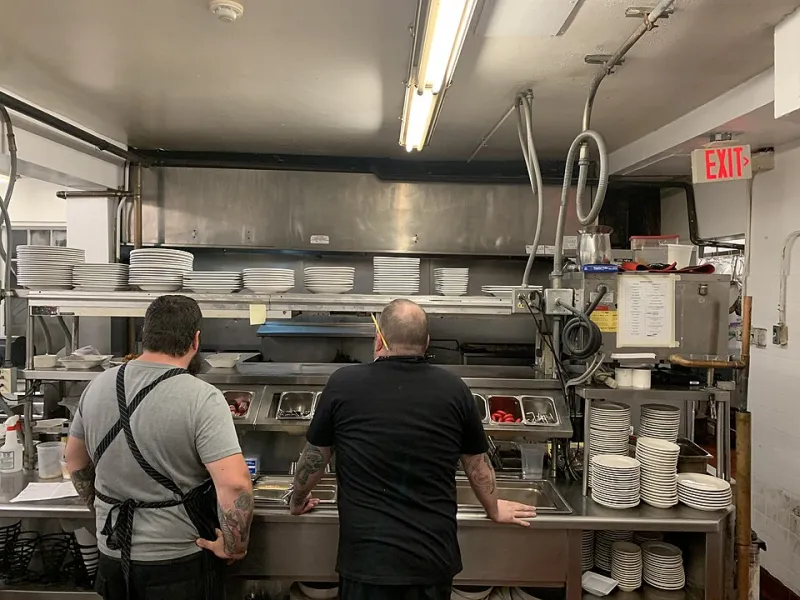
This pillar requires direct observation during service. Walk the line during a representative dinner service and note where the flow stalls. Where are cooks waiting on equipment to cycle, recover temperature, or complete a process? Where are workarounds in place — a second fryer being used to compensate for one that no longer maintains consistent oil temperature, or a reach-in cooler being supplemented by sheet pans stored in a walk-in because the primary unit cannot hold adequate volume?
These workarounds are workflow taxes. They consume time, introduce inconsistency, and represent latent labor costs that do not appear on any single invoice but accumulate meaningfully across hundreds of service hours.
Scoring and Prioritizing Your Findings
Once data is gathered across all four pillars, assign each piece of equipment a composite score. A simple matrix that rates energy performance, repair burden, utilization alignment, and workflow contribution on a scale of one to five provides a structured basis for comparison. Equipment scoring in the lower range across multiple pillars warrants immediate evaluation for replacement. Equipment with a single underperforming dimension may be a candidate for targeted repair or recalibration.
This scoring approach also creates a defensible record for capital expenditure conversations with ownership, investors, or lending partners. Equipment replacement decisions grounded in documented performance data are far more persuasive than those driven by intuition or frustration.
Timing Your Audit Strategically
For most US food service operations, the optimal window for a comprehensive audit falls either in the slower post-holiday period in January or during the shoulder season between summer and fall. These periods tend to offer slightly more operational bandwidth for the observation and data-gathering phases without the disruption of peak service weeks.
Plan for the audit to span two to three weeks: one week for data collection, one week for analysis and scoring, and a final week for prioritization and vendor consultation. This timeline is realistic for a working kitchen and produces actionable output without requiring an operational shutdown.
From Audit to Action
The audit itself is not the end goal — the decisions it enables are. With a clear prioritization list in hand, operators can approach equipment upgrades methodically, staging replacements to manage capital outlay while addressing the highest-impact inefficiencies first. In many cases, operators discover that replacing two or three chronically underperforming appliances eliminates a disproportionate share of the hidden costs identified in the audit, delivering measurable returns well within the first operating year.
A well-equipped professional kitchen is not simply one stocked with capable tools. It is one where every piece of equipment is earning its place — performing to specification, supporting workflow, and contributing to rather than eroding profitability. The audit is the mechanism that ensures that standard is maintained, year after year.